If you own a condo in Puerto Vallarta, Nuevo Vallarta or Bucerías and rent it to visitors, you already know the math: between the host fee, the guest fee and the pressure to discount, a meaningful slice of every booking never reaches you. Direct bookings fix that — but only if you treat your rental like a small hospitality business instead of a listing that happens to have a website.
We work with owners, property managers and boutique hotels across Bahía de Banderas, and the pattern repeats: the properties that earn 30–50% of their nights directly did not get there with a prettier listing. They got there with a system — a website that can actually take a booking, a Google presence that shows up when someone searches the neighborhood, a way to stay in touch with past guests, and a reason for a traveler to book with them instead of the platform. This guide walks through that system in the order we would build it for you.
Why direct bookings matter more in Puerto Vallarta than in most markets
Three features of this market make the case unusually strong.
- Repeat visitors. Vallarta is a return destination. A large share of winter guests come back year after year, often to the same building. A repeat guest who found you once on a platform has no reason to pay platform fees twice — unless you never gave them a way to reach you.
- Long stays. Snowbirds booking four to twelve weeks are exactly the guests for whom the platform's percentage becomes painful in absolute dollars. They are also the most willing to book direct, because they have time to research and want a human on the other end.
- Building-level competition. In towers like the ones along the Marina, the Hotel Zone or Nuevo Vallarta, you are not competing with the city — you are competing with forty near-identical units in your own elevator bank. On a platform, price is the only differentiator. On your own channel, you can win on trust, photos, flexibility and service.
None of this means leaving the platforms. Airbnb and Vrbo remain the best acquisition channel for first-time guests. The goal is to stop renting that audience and start owning the relationship with the guests you already have.
Step 1: A website that can actually take a booking
The single most common mistake we see is a "website" that is a brochure with a contact form. A traveler comparing your unit against a platform listing at 11 p.m. wants to see live availability, a total price with taxes and cleaning, and a way to pay — right now. If any of those three is missing, they go back to the platform where all three exist.
The non-negotiables
- A real availability calendar synced with your platform calendars (iCal at minimum, a channel manager if you run more than two or three units) so you never double-book.
- Transparent pricing per night and per stay, in the currency your guests think in (usually USD or CAD, with MXN available), including cleaning and taxes. Hidden fees are the reason people distrust direct sites.
- Online payment with a card — Stripe, Mercado Pago or a PayPal checkout — plus a clear cancellation policy. "Send us a wire transfer" kills conversion with North American guests.
- Photos that beat your own listing. Guests expect the direct site to be the best version of the property. If your Airbnb photos are better, you have told them where to book.
- Mobile-first speed. A large share of this traffic arrives from an Instagram profile or a WhatsApp link on a phone. If the page takes five seconds, they are gone.
For a single unit or a small portfolio this does not require custom software; a well-configured booking engine on a fast site does the job. When you manage multiple owners' units, the picture changes — see the section on property management below. If you are starting from zero, our web design for hotels and villas service was built precisely around this checklist.
Trust signals that replace the platform's guarantee
Part of what a guest pays a platform for is protection. Your site has to compensate visibly: real reviews (imported from the platforms, with permission, or collected directly), a named host with a photo, a physical address or building name, a clear "what happens if…" page, and a WhatsApp button that actually gets answered. In this market a fast, friendly WhatsApp reply is worth more than any badge.
Step 2: Show up on Google for the searches that matter
Most direct-booking guides skip local search, which is strange, because it is where the intent is highest. Someone typing "condo rental Marina Vallarta 2 bedroom" or "long term rental Bucerías winter" is not browsing; they are shopping.
Google Business Profile for a rental
A vacation rental can and should have a Google Business Profile, especially if you offer a local pickup or check-in point. Fill every field, load thirty-plus photos, set the category correctly ("Vacation home rental agency" or "Holiday apartment rental"), and — this is the part owners skip — collect reviews there, not only on the platforms. Google reviews are visible to every searcher; platform reviews are visible only to people already inside that platform.
Pages that answer real questions
Your site should have one page per property and a handful of pages that answer what your guests actually ask: which neighborhood to choose, what a winter stay looks like, how to get from the airport, what the building includes. Written honestly and specifically, these pages rank for long-tail searches that platforms do not target, and they pre-sell the stay. We cover the mechanics in detail in our guide to SEO in Puerto Vallarta; the short version is that specificity wins — "Nuevo Vallarta" beats "Mexico," and "walking distance to the Marina malecón" beats "great location."
Make the property citable by AI assistants
An increasing number of travelers now ask ChatGPT, Gemini or Google's AI Overview for recommendations before they ever open a search result. Those systems favor pages with clear, structured, verifiable facts: exact location, number of bedrooms, amenities, policies, prices ranges, real reviews. A property page written as a list of concrete facts is far more likely to be quoted than one written as a poem about sunsets. This is the same principle behind our AI SEO work for local businesses, and it applies to a single condo just as well.
Step 3: Turn one platform booking into a direct relationship
This is the highest-return step and the one most owners neglect. Every platform guest is a future direct guest if you handle the stay right.
- Collect contact details legitimately. A welcome guide, a Wi-Fi card, a check-in form or a house manual with a QR code to your site are all natural moments to obtain an email or WhatsApp number — with consent, and without violating platform rules about steering the current booking off-platform.
- Follow up after checkout with a genuine thank-you and a "book direct next time" offer: a modest discount, a free late checkout, an airport pickup — something the platform cannot match.
- Stay in touch two or three times a year, not weekly. A short note before the winter season opens, a heads-up about a local event, a photo of the renovated terrace. Email still works beautifully for this audience; see our email marketing services for how we set up simple, automated sequences for owners.
- Ask for the Google review — the one that helps you outside the platform.
Owners who do only this step, consistently, typically see a third of returning guests move to direct within two seasons.
Step 4: Paid campaigns that make sense for a rental
Paid ads for a single unit rarely pay off broadly, but two narrow uses do:
- Brand and building searches. If your building or your property name gets searched (many do), a small Google Ads campaign on those exact terms guarantees you appear above the platforms for people who already want you. The cost is trivial because the audience is tiny and the intent is total.
- Retargeting past visitors. Someone who spent three minutes on your site in October and left is a reasonable person to remind in November. Meta's retargeting does this for a few dollars a day during the booking window.
Broad "vacation in Mexico" targeting is where owners burn money. If you want a second opinion on a campaign before spending, our team runs Google Ads and Meta Ads in Puerto Vallarta for hospitality clients and will tell you honestly when an ad is not the right tool.
Step 5: Instagram as a booking channel, not a photo album
Instagram is the second-largest source of direct inquiries we see for Vallarta rentals, behind repeat guests. What works is not polished feed posts but short, specific video: the actual view from the actual balcony at 7 a.m., the walk to the beach in real time, the coffee place downstairs. Reels of that kind reach people planning a trip; aesthetic carousels reach other owners. Put the direct-booking link and a WhatsApp button in the profile, respond to DMs fast, and post consistently before the high season — September through November is when winter stays get decided. If producing that content yourself is the bottleneck, that is exactly what our professional Reels production in Puerto Vallarta is for.
If you manage several owners' properties
Everything above scales — until it doesn't. Around eight to ten units, the spreadsheet-and-WhatsApp approach starts costing bookings: calendars drift, owner statements take days, and guests fall through the cracks. At that point the right move is a property management system that handles bookings, owner reporting, cleaning schedules and payments in one place. We build one specifically for this market; you can see how it works at our property management software page. The point is not the software itself — it is that professional managers in Vallarta compete for owners on transparency, and a real owner portal is the fastest way to win that argument.
For a sense of what a direct-booking presence looks like when it is done well, look at how PV Rents presents its Puerto Vallarta rentals and management services, or how Aria Ocean Rentals focuses on a single development in Nuevo Vallarta. Both are structured to be found, trusted and booked without a platform in the middle.
A realistic 90-day plan
- Weeks 1–3: booking-capable site live, calendars synced, payment tested, WhatsApp button working, Google Business Profile complete.
- Weeks 4–6: one page per property with concrete facts, three neighborhood or how-to pages, review requests set up for every checkout.
- Weeks 7–9: past-guest list assembled, first "book direct" email sent before high season, brand-term ad campaign switched on.
- Weeks 10–13: Reels cadence of one or two a week, retargeting on, first month of data reviewed: where did direct inquiries come from?
Frequently asked questions
Is it against Airbnb's rules to encourage direct bookings?
It is against their rules to move a booking that started on Airbnb off the platform, or to share contact information for that purpose before the reservation is confirmed. It is not against any rule to run your own website, to have a Google Business Profile, to answer a past guest who writes to you directly, or to market to people who have never been in the platform's funnel. Keep the current booking on the platform, and build the relationship for the next one.
How much of my occupancy can realistically come from direct bookings?
For a well-run single unit in a good location, 25–40% of nights within two seasons is a realistic target, mostly from repeat guests and referrals. Boutique properties and small managers with a real brand routinely pass 50%. Starting from zero, expect the first season to be mostly setup and list-building; the payoff shows in the second.
Do I need a bilingual website?
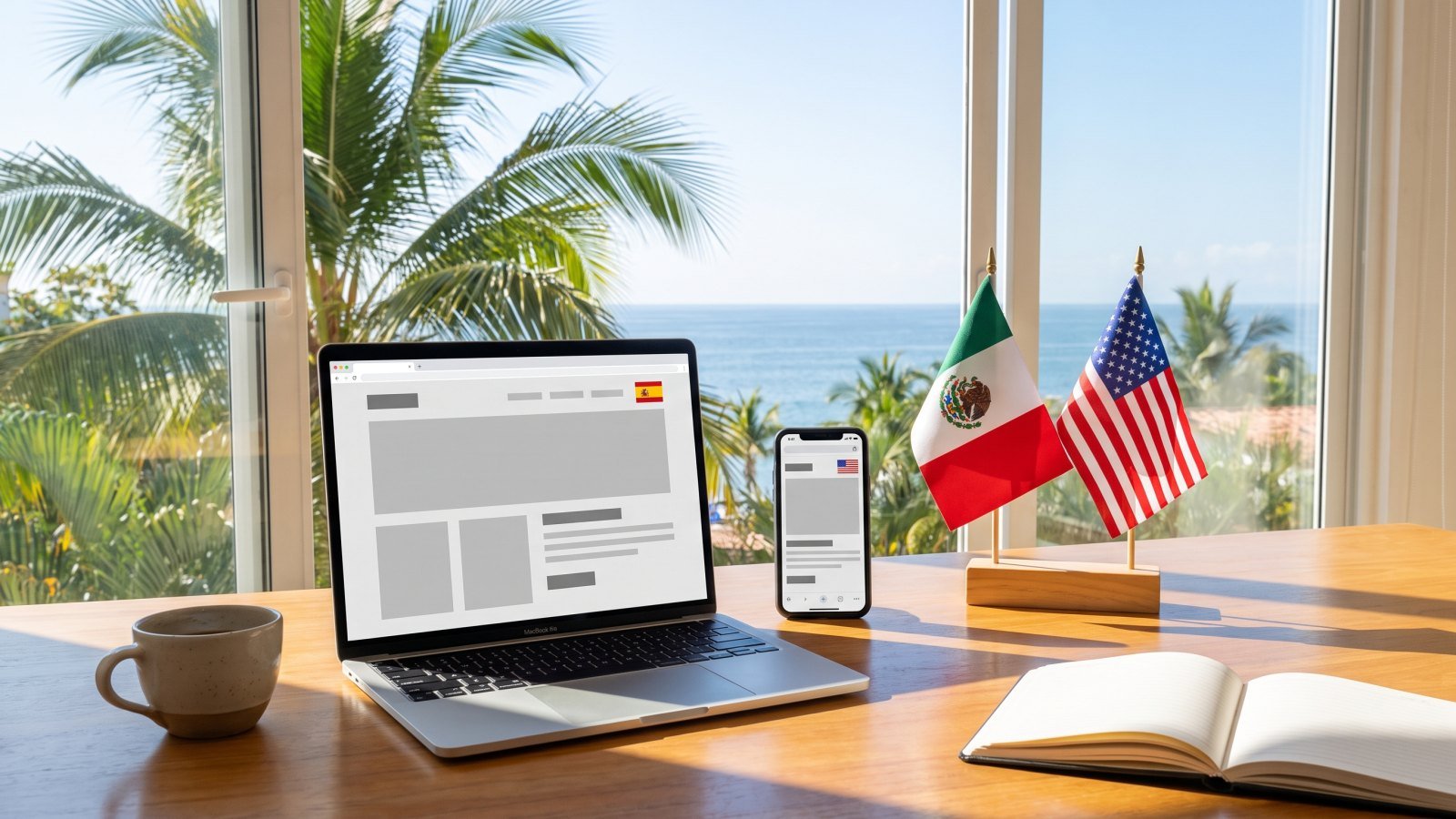
If your guests are primarily from the US and Canada, English comes first. Spanish matters if you also rent to national tourists (Guadalajara and Mexico City are large summer markets) and for local search signals. A bilingual site done properly is not twice the work if it is planned from the start — we wrote a separate guide on bilingual websites for Puerto Vallarta businesses.
Should I charge less on my own site?
Match the platform's guest-facing total or come in slightly below it, and add a benefit rather than a deep discount. You are already saving the fees; the goal is to make direct the obvious choice, not to start a price war with yourself.
What about the new short-term rental regulations?
Jalisco and Nayarit municipalities have been tightening registration, tax and building-rule requirements for short-term rentals. A direct-booking business should be squarely compliant — registered, invoicing where required and respecting building bylaws — because your own name is on it. If you are unsure about your status, get local legal advice before you scale; a firm such as PV Law Firms works with foreign owners on exactly these questions.
Can I do all of this myself?
Yes, and many owners do the guest-relationship part very well themselves — it is mostly discipline. The parts that usually justify outside help are the booking-capable site, the local SEO structure and consistent video. If you want an honest assessment of which parts to outsource, talk to us; we will tell you what you can skip.
The bottom line
Direct bookings in Puerto Vallarta are not a trick; they are a consequence of running the rental as a small hospitality brand. A site that can take the booking, a Google presence that finds the shopper, a guest list you actually keep in touch with, and short honest video before the season — that is the whole system. Build it once, and every winter it compounds.